Independent IFS Cloud practice · Data mesh, step 2 of 8
Identify data domains in IFS Cloud: draw the boundaries along the business, not the menu
A data domain is a group of related data that belongs to one business function, such as sales, procurement, inventory or finance, together with the team that answers for it. In an IFS Cloud company, identifying data domains means deciding which business team owns which data, and where the company and site structure sits inside each domain rather than splitting it.
Domains are the second step of a data mesh, after the vision. Every later step, from teams to data products, is organised around them.
Key takeaways
- Data mesh draws domain boundaries along the organisation: in Zhamak Dehghani's words, it “follows the seams of organizational units”. In IFS Cloud that means business functions, not modules, companies or sites.
- Company and site are keys inside a domain's data. An inventory part in IFS Cloud is identified by site and part number, so the inventory domain covers all sites, and site connections decide which records a user sees.
- Every domain has one named owner who answers for quality, security and sharing of its data, in the way a product owner answers for a product.
- Data used by two domains, such as supplier data used by purchasing and by accounts payable, gets one owner and a written agreement on what the other domain receives.
- Start with the one or two domains behind the decisions named in the vision, and review the boundaries when the organisation changes.
1.What is a data domain in a data mesh?
A data domain in a data mesh is the unit of data ownership: one business area, the data it creates and uses, and the team responsible for making that data usable by others. The first of the four principles in Data Mesh Principles and Logical Architecture (Dehghani, martinfowler.com, December 2020) is domain-oriented decentralized data ownership and architecture. The article states that data mesh follows the seams of organizational units as the axis of decomposition.
Some examples make the boundary concrete. A sales domain holds customers and customer orders, with the revenue they produce. A finance domain holds supplier invoices and payments, next to budgets. Procurement holds suppliers and purchase orders, including purchase prices. Each domain treats the data it shares as a product, so the team in charge answers for quality and ease of use for colleagues in other domains.
The ownership rules that follow from this are described in ownership and quality standards in data mesh for IFS Cloud.
2.Should a data domain follow IFS Cloud companies and sites?
A data domain should not be one IFS Cloud company or one site, because company and site are keys within the data of a business function, not the function itself. Two facts from the IFS Cloud documentation show why.
- Site is part of the identity of the record. In the IFS Cloud 24R2 analysis model documentation for the inventory part dimension, the site (CONTRACT) is the natural key and the inventory part is built from site and part code. The same part number at two sites is two inventory part records.
- Site connection already filters visibility. The 24R2 page on connecting a site to a user states that the user can only see records belonging to the sites connected to the user, and that only sites attached to the user's company can be selected.
So an inventory domain covers inventory parts at every site, and site appears as a column that consumers filter on. Splitting the domain per site would create several owners for the same definitions, such as what “available stock” means, and those definitions would drift apart.
The exception is a company or site that runs a genuinely different business with its own management, for example a service subsidiary next to a manufacturing company. There the organisational seam runs along the company, and a separate domain can be right. The test is the organisation chart, not the IFS Cloud configuration.
3.How do you identify data domains step by step?
Identifying data domains is a mapping exercise that ends with a named owner for every domain. I run it in five steps:
- List the business areas. Start from how the company is organised: sales, procurement, inventory and logistics, manufacturing, finance, HR. Use the organisation chart and the current-state assessment from step 1.
- List the data each area creates and uses. For each area, note the records it creates in IFS Cloud every day and the records it only reads. Creating is the signal for ownership. A buyer creates purchase orders; a planner reads them.
- Check against the modules in use. Note which IFS Cloud functional areas each business team works in. A team that works in several functional areas can still be one domain, and one functional area can serve two teams. The module list is a cross-check, not the answer.
- Name an owner. Each domain gets one person who answers for the quality and the security of its data, and for how it is shared, usually the manager of that business area or someone they appoint.
- Write the domain rules. Record what data the domain covers, who may use it and through which channel, and which shared definitions it must follow.
A more detailed method for mapping business areas to data, and the mistakes that make it fail, is in data domain mapping. A view of how IFS functional modules line up with business domains is in mapping IFS functional modules to business domains.
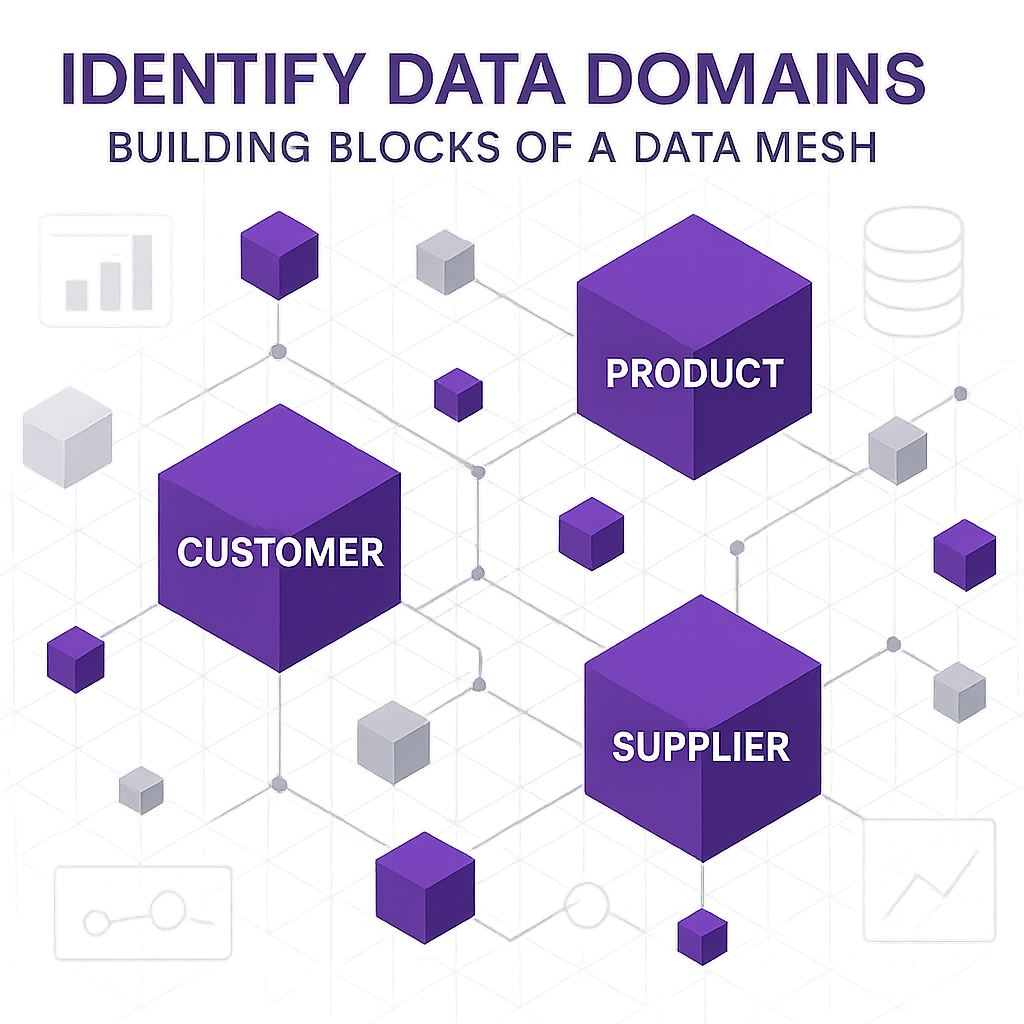
4.What does a first domain map look like?
A first domain map fits on one page and lists, for each domain, the data it owns, the data it only reads from others, and the owner role. The map below is illustrative for a manufacturing company on IFS Cloud, not a client record.
| Domain | Owns | Reads from other domains | Owner role |
|---|---|---|---|
| Sales | Customers, customer orders, prices to customers | Available stock (inventory), credit status (finance) | Sales manager |
| Procurement | Suppliers, purchase orders, purchase prices | Demand (planning), supplier invoices (finance) | Purchasing manager |
| Inventory | Inventory parts per site, stock levels, locations | Purchase orders (procurement), customer orders (sales) | Logistics or warehouse manager |
| Finance | Supplier and customer invoices, payments, budgets | Purchase orders (procurement), customer orders (sales) | Financial controller |
The “reads” column is the start of the list of data products each domain must deliver to others, which is step 4: define and deliver data products.
5.How do you resolve overlapping domains and unclear ownership?
An overlap is resolved by giving the data one owner and writing down what the other domain receives, in what form and with what quality. Supplier data is the typical case in IFS Cloud projects: purchasing creates the supplier and uses it on purchase orders, while accounts payable needs correct payment and tax details on the same supplier. If both domains feel they own it, both edit it, and nobody answers for it.
Three situations come up again and again:
| Situation | What to do |
|---|---|
| Two teams claim the same data | Agree a boundary in a meeting with both owners. One domain owns the record; the other gets a written data sharing agreement that says which fields it relies on and how changes are announced. |
| Nobody wants to own a domain | Escalate to the sponsor. A domain without an owner produces poor data, and leadership has to assign the role and the time that goes with it. |
| The business changes | Review the domain map when the organisation changes, for example after an acquisition or a new site. Domains can be split, merged or moved. |
Written agreements between domains are covered in confirm sharing agreements.
6.Which governance rules apply to each domain?
Each domain follows company-wide rules for privacy, security and data quality, and its owner answers for the team keeping them. A small central group sets those common standards and checks that domains fit together, which is the federated model described in step 6, apply federated computational governance.
In IFS Cloud, access to a domain's data is a permission set question. The permission set overview (25R1) defines a permission set as a collection of access grants assigned to objects and privileges, and notes that pages depend on projections to retrieve data. When the domain rules say who may use the data, the domain owner should be able to name the permission set that implements it.
7.Checklist: are the domains ready for step 3?
The domains are ready when you can confirm each point below:
- Every major business area is listed.
- For each area, the data it creates and the data it only reads are recorded.
- Company and site are treated as keys inside domains, unless a company runs a separate business.
- Every domain has one named owner, confirmed by the sponsor.
- Each overlap has one owner and a written agreement for the other domain.
- The domain rules state what data is covered and who may use it.
- A review date or trigger for the domain map is set.
The next step staffs each domain with the people who will build and run its data products: form cross-functional data product teams. The previous step, the vision, is in define vision and align strategy for data mesh. If you want help drawing the first domain map for your IFS Cloud company, my services for IFS Cloud cover data governance work of this kind.
8.Frequently asked questions
What is a data domain in data mesh?
A data domain in data mesh is a group of related data that belongs to one business function, such as sales, procurement, inventory or finance, together with the team responsible for it. The domain team answers for the quality of that data and shares it with other domains as a product.
Should each IFS Cloud site or company be its own data domain?
An IFS Cloud site or company is usually not its own data domain. Site and company are keys inside the data of a business function: an inventory part in IFS Cloud is identified by site and part number, and users only see records of the sites connected to them. A company becomes a separate domain only when it runs a separate business with its own management.
Are data domains the same as IFS Cloud modules?
Data domains are not the same as IFS Cloud modules. A data domain follows the organisation, meaning the business team that creates and answers for the data. The list of IFS Cloud functional areas in use is a cross-check: one team can work in several functional areas, and one functional area can serve more than one team.
Who owns supplier data, procurement or finance?
Supplier data in a data mesh gets one owning domain, chosen by who creates and maintains the supplier record, often procurement. Finance, which relies on payment and tax details of the same supplier, receives a written data sharing agreement listing the fields it depends on and how changes are announced. Two owners for one record means nobody answers for it.
Which data domains should a data mesh start with?
A data mesh should start with the one or two data domains behind the business decisions named in the data mesh vision, for example the customer domain if customer data drives the most important decisions. An early, visible result in one domain builds support for the next, and the domain map is reviewed as the organisation changes.
9.About the author
Dariusz Myśliwiec: 18 years hands-on with IFS (Apps 7.5–10 and IFS Cloud). Based in Kraków, delivering remotely across Europe and globally through an independent practice. You talk to the consultant who does the work, not a sales layer.
IFS is a registered trademark of IFS AB; this practice is not affiliated with IFS AB.
Name the owner of your supplier data
If two departments in your company would both answer “we do”, or neither would, the domain map is the place to start. A short call is enough to sketch the first version.
Book a call about your data domains See services for IFS Cloud