

IFS Cloud ERP Consulting Services | Data Migration & SCM Expertise
  1. You are here:  
  2. Home
  3. Offer
IFS-ERP CRIMS customization of IFS Cloud
IFS Cloud expert delivering fast, secure rollouts and data migration with proven methods that cut risk and keep supply chain projects on track.
Portfolio ID: SRV-IFS-CLOUD-ALL | Provider: IFS-ERP.consulting

Comprehensive IFS Cloud Services Portfolio

End-to-end implementation, data migration, security hardening, and post-go-live optimization for Manufacturing & Logistics.

Status: Active Type: Expert Services IFS Cloud Native

1. IFS Cloud Implementation (Manufacturing & Logistics)

1.1 The 8-Month Fixed-Price Model

We eliminate the "never-ending project" risk. By utilizing industry-specific pre-configurations and the IFS Focus methodology, we deliver a fully functional system in a predictable timeframe and budget.

  • End-to-End Coverage: From initial Value Stream Mapping to final Go-Live.
  • Fixed Price: No hidden costs or "scope creep" surprises.
  • Industry Best Practices: Built-in processes for modern supply chains.
Key Milestones
  1. Business Blueprint Approval (Month 2)
  2. Conference Room Pilot - CRP (Month 5)
  3. User Acceptance Testing - UAT (Month 7)
  4. Go-Live & Hypercare (Month 8)

2. Data Migration Accelerator

Data migration is often the biggest bottleneck in ERP projects. Our Migration Accelerator is a proprietary toolset designed to automate, validate, and execute data transfers from legacy systems to IFS Cloud.

Feature Benefit
Automated Mapping Reduces manual entry errors by 70%.
Pre-Load Validation Identifies "dirty data" before it touches the IFS environment.
Historical Data Logic Seamlessly handles open balances and transaction history.

3. Security & Permission Sets Hardening

Closing the Security Gap

Post-implementation, many organizations operate with overly broad "full access" roles. We perform deep-dive audits to implement Role-Based Access Control (RBAC) and ensure Segregation of Duties (SoD) compliance, protecting your business from internal risks.

4. Hypercare & Continuous Optimization

Go-Live is just the beginning. Our Hypercare program ensures system stability, while our optimization services help you leverage advanced IFS Cloud features like:

IFS Lobbies

Role-specific dashboards for real-time visibility.

Custom CRIMS

Tailored extensions and reports (Updates-safe).

Process Governance

Ongoing alignment of IFS with your business growth.

Frequently Asked Questions

We use a "Standard-First" approach. By strictly defining the scope around IFS Cloud core functionalities and industry-standard processes during the blueprint phase, we eliminate the variables that typically drive costs up.

Yes. All our modifications are developed using Evergreen-compliant methods (Custom Attributes, Page Configurations, and Workflow Engines). This ensures they remain stable and functional through every IFS Cloud update cycle.
Request a Consultation

Visit ifs-erp.com for the full library of IFS Cloud add-ons and reports.

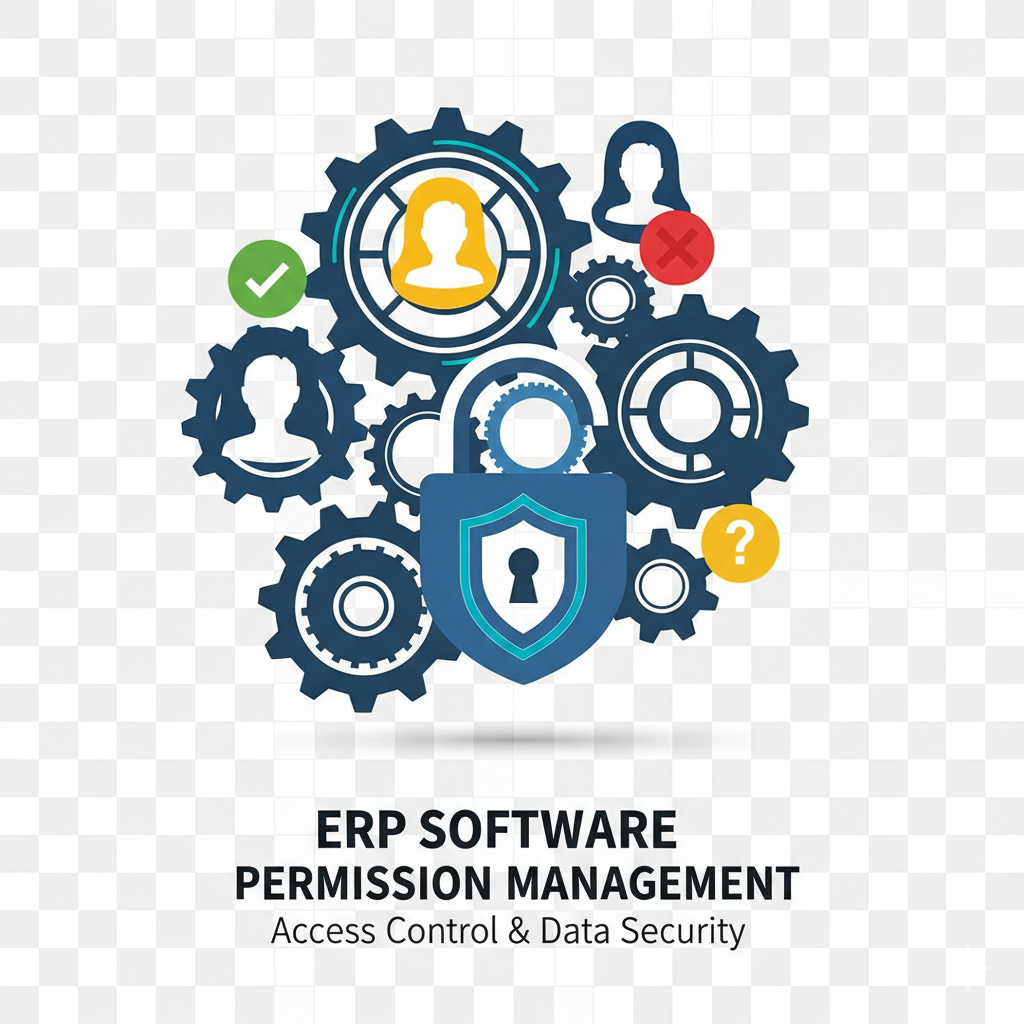
Precision Permission Set Configuration for IFS Cloud

TL;DR

Executive Summary for CIOs and Security Officers

Securing an ERP system like IFS Cloud requires more than just assigning passwords; it demands a granular, strategic approach to Permission Set Configuration. Improper access controls lead to three primary risks: data breaches, failed compliance audits (GDPR, SOX), and inflated licensing costs.

Our service provides a comprehensive solution that moves beyond standard templates. We offer:

  • Granular RBAC Architecture: Aligning system access strictly with job functions.
  • Compliance Assurance: Enforcing Segregation of Duties (SoD) and PII protection.
  • License Optimization: Ensuring users aren’t over-provisioned, reducing software costs.
  • Audit Readiness: Creating transparent, documented access frameworks that satisfy external auditors.

The Bottom Line: We transform your security model from a reactive headache into a proactive asset, ensuring your data is locked down, your users are efficient, and your audits are seamless.

The Critical Imperative of Precision Access Control in IFS Cloud

In the modern enterprise landscape, the Enterprise Resource Planning (ERP) system functions as the central nervous system of the organization. It houses your most critical assets: proprietary engineering data, financial records, employee personnel files, and supply chain strategies. Consequently, in a regulated and threat-laden digital environment, controlling user access to this sensitive information is not merely an IT task — it is a boardroom-level critical success factor.

IFS Cloud offers robust, sophisticated access control capabilities designed to handle complex global operations. However, the flexibility of the platform is a double-edged sword. Without a deliberate, expert-driven configuration strategy, organizations often fall into the trap of «over-provisioning» — granting broad access to ensure users aren’t blocked, thereby leaving the digital back door wide open. Effectively configuring these controls requires deep expertise in both the functional business processes and the technical architecture of IFS Cloud Projections and Entities.

Our Precision Permission Set Configuration Services are designed to bridge the gap between technical capability and business necessity. We ensure your sensitive data is protected, strict compliance requirements are met, and users have precisely — and only — the access they need to perform their roles efficiently.

The Strategic Value of Permission Architecture

Beyond Security: The Efficiency Paradox

There is a common misconception that «high security» equals «low productivity.» In the context of IFS Cloud, the opposite is true. When permission sets are poorly configured or overly generic, users are often presented with a cluttered interface, filled with buttons, menus, and data fields irrelevant to their jobs. This cognitive load slows down processing time and increases training requirements.

Effective, precision permission set configuration enables productivity by curating the user experience. By removing the «noise» of unauthorized modules, we streamline the user interface. A warehouse operative sees only inventory transactions; a financial controller sees only ledgers and approvals. Our services help you strike the perfect balance between ironclad security and seamless usability, ensuring your IFS Cloud environment is both secure and user-friendly.

The Cost of «Good Enough»

Many organizations rely on legacy permission structures migrated from older versions of IFS (such as IFS Applications 9 or 10) or utilize default «out-of-the-box» roles. This approach creates significant risks:

  • Data Breaches: Unrestricted read-access allows internal bad actors to harvest data.
  • Compliance Violations: Failure to segregate duties (e.g., the ability to create a vendor and approve a payment to that vendor) guarantees audit failure.
  • Operational Inefficiencies: Users accidentally modifying configuration data they shouldn’t have access to, causing system downtime.

Our Professional Scope: A Phased Methodology

We do not believe in «one-size-fits-all» security. Our methodology is a rigorous, cyclic process designed to tailor the IFS Cloud security model to your specific organizational DNA.

1. Role-Based Access Control (RBAC) Analysis

We begin with a deep-dive discovery phase. This involves a thorough analysis of your organizational structure, analyzing Functional Roles versus Job Roles. We interview process owners to understand not just what a user does, but what data they need to consume versus manipulate.

This allows us to define clear access requirements that align with real-world job functions and internal control policies. By strictly mapping permissions to roles rather than individuals, we eliminate «permission creep» and ensure that onboarding and offboarding are streamlined and secure.

2. Custom Permission Set Design & Implementation

Moving from theory to practice, our experts meticulously design tailored permission sets. In IFS Cloud, this requires navigating the complex layer of Projections (the API layer) and Presentation Objects.

We avoid the use of «Select All» grants. Instead, we implement a granular approach, granting access only to specific methods and actions. For example, a user may be able to view a Customer Order but not release credit holds. This level of detail ensures that users can perform their tasks without unnecessary restrictions while maintaining the integrity of sensitive information.

3. Segregation of Duties (SoD) & Compliance Engineering

For publicly traded companies or those in highly regulated industries, Segregation of Duties is non-negotiable. We configure your IFS Cloud permission sets to address SoD conflicts specifically. We utilize matrix analysis to ensure that no single Permission Set or combination of sets assigned to a role, grants toxic combinations of access.

We ensure adherence to:

  • GDPR/CCPA: implementing «History Log» configurations and read-access restrictions on screens containing PII (Personally Identifiable Information) like HR records and private contact details.
  • SOX (Sarbanes-Oxley): Ensuring financial controls are enforced via system limitations, preventing fraud and error in financial reporting.
  • HIPAA: For organizations handling health data, ensuring strict compartmentalization of patient-related records.
  • ITAR/​Export Control: Restricting access to part catalog data and technical specifications based on the user’s nationality or clearance level, a critical requirement for aerospace and defense clients.

4. User Group & Profile Management Architecture

Permission Sets control functional access, but User Groups and Profiles control data visibility and user experience. Effective management of these elements is key to scalable administration.

We help you structure User Groups (to control access to specific Sites, Companies, or GL accounts) and Base Profiles (to control the layout of Aurena pages) in a way that simplifies management. By standardizing profiles, we ensure that when a permission set is applied, the UI adapts automatically, hiding the navigation items that the user cannot access, thereby creating a cleaner workspace.

5. Rigorous Testing, Auditing & Verification

Configuration is nothing without validation. We employ a «Negative Testing» philosophy. It is not enough to prove that a user can do their job; we must prove that they cannot do what is forbidden.

Our testing phase includes:

  • Unit Testing: Verifying individual permission sets against technical specifications.
  • Integration Testing: Verifying that combined roles do not create SoD conflicts.
  • UAT (User Acceptance Testing): engaging key business users to validate that the security model does not impede legitimate business workflows.

This comprehensive verification is critical for maintaining the integrity of your security framework and passing external audits.

6. Documentation & Knowledge Transfer

A «Black Box» security configuration is a liability. If only the consultant understands the setup, the organization remains vulnerable. Clear, audit-grade documentation is a core deliverable of our service.

We provide Security Matrices, SoD Conflict Reports, and Administrator Guides to empower your internal IT team. We conduct training sessions to ensure your administrators can confidently manage routine requests, troubleshoot access issues, and maintain security settings, reducing dependency on external support and enhancing your internal capabilities.

7. Ongoing Review & Lifecycle Optimization

Security is not a project; it is a process. As your business evolves — through M&A activity, new module implementation (e.g., adding Field Service Management), or restructuring, your security needs will shift.

We offer ongoing review and optimization services (Security Health Checks) to ensure your permission sets remain relevant. We analyze IFS Cloud Updates (released twice a year) to assess if new functionalities introduce new security objects that need to be locked down or granted, ensuring your security posture adapts to the changing regulatory and software landscape.

The Impact on Licensing and TCO

One often overlooked aspect of Permission Set configuration is its direct impact on the Total Cost of Ownership (TCO) regarding IFS software licensing. IFS Cloud licensing models often distinguish between «Full Users» and «LTU» (Limited Task Users).

If permissions are configured loosely, a user who only needs to perform simple time reporting or requisition approvals might inadvertently be granted access to screens that trigger a «Full User» license requirement. Our Precision Configuration ensures that users are strictly contained within the bounds of the most cost-effective license type available for their role. By optimizing permissions, we frequently help clients realize significant savings on their annual maintenance and subscription costs.

Protect Your Most Valuable Asset: Your Data

In the digital age, data is currency. Its theft, corruption, or unavailability can bankrupt a company or destroy its reputation. With expertly configured IFS Cloud permission sets, you achieve the «Holy Grail» of ERP management: the perfect equilibrium of hardened security, rigorous compliance, and optimized user efficiency.

Our services are designed to fortify your ERP system from the inside out. We move you away from the anxiety of the «Super User» culture and into a mature, governed state where you have absolute confidence that your data is protected and your users are empowered to succeed.

Ready to Fortify Your IFS Cloud Security?

Don’t wait for a data breach or a failed audit to address your access controls.

If you’re ready to enhance the security, compliance, and efficiency of your IFS Cloud environment, contact us today.

Schedule a Permission Set Security Review

Our experts will work with you to design a solution tailored to your unique organizational needs.

Frequently Asked Questions

Standard implementations often rely on «Base» or «Template» roles provided by IFS, which are designed for demonstration or generic use. These templates are typically overly permissive to prevent errors during testing. «Precision» configuration involves building Permission Sets from the ground up, based on your specific business processes (Projections and Entities), ensuring the Principle of Least Privilege is enforced. It is tailored, not generic.

In IFS Cloud, RBAC is achieved by creating «Permission Sets» (groups of technical privileges) and assigning them to Users. RBAC is crucial because it aligns user permissions with their job functions (e.g., «Accounts Payable Clerk») rather than the individual person. This reduces the risk of unauthorized access, simplifies onboarding, and ensures that when a user changes jobs, their access is updated systematically, enhancing both security and operational efficiency.

While no service provider can «guarantee» compliance (as it relies on ongoing human behavior), we configure the system controls to adhere strictly to these mandates. For GDPR, we mask PII and implement history logging. For SOX, we build Segregation of Duties (SoD) matrices to prevent conflict of interest in financial transactions. We provide the technical framework and reports that auditors require to sign off on your system’s compliance.

The timeline varies based on the complexity of your organization and the number of distinct roles. A basic implementation might take 4 – 6 weeks, while a complex global rollout with strict SoD requirements could take 3 – 6 months. The process includes analyzing your organizational structure, designing custom sets, iterative building, rigorous negative testing, and final deployment.

Yes, significantly. IFS licensing distinguishes between Full Users and Limited Task Users (LTU). By refining permission sets to include only the necessary projections for a role, we often find that users categorized as expensive «Full Users» can be restricted to «LTU» status without hindering their work. This optimization can save substantial amounts in annual recurring license fees.

A Functional Role is a set of system privileges related to a task (e.g., «Create Purchase Order»). A Job Role is the collection of Functional Roles that a person performs (e.g., «Purchasing Manager» might include «Create Purchase Order,» «Approve Requisition,» and «View Supplier Stats»). We build permission sets at the Functional level and stack them to create Job Roles, offering the highest flexibility and ease of maintenance.

Yes. Negative testing is a core component of our audit strategy. It involves logging in as a specific role and attempting to perform actions they should not be able to do (e.g., a Receiver trying to Pay an Invoice). Proving that the system blocks these actions is the only way to validate the security model truly works.

IFS Cloud updates (released twice yearly) often introduce new Projections and functionality. Without maintenance, permission sets can become outdated or break specific workflows. We offer ongoing support services to review Release Notes, test new functionalities against your security model, and update permission sets to ensure business continuity and security are maintained post-update.
Professional Data Migration Services for IFS Cloud

TL;DR

Executive Summary: Data migration is the single largest risk factor in any IFS Cloud implementation. It is not merely a technical «lift and shift» of rows and columns; it is a strategic reconstruction of your business’s digital backbone. Our Professional Data Migration Services mitigate this risk through a rigorous, audit-compliant methodology utilizing the IFS Data Migration Manager (DMM). We move beyond basic extraction and loading to perform comprehensive data sanitization, structural transformation, and iterative validation (Mock Loads). By categorizing data into Basic, Master, and Transactional tiers and employing a phased «Delta Load» cutover strategy, we ensure zero data loss, maintain strict regulatory compliance (GDPR), and guarantee that your system goes live with high-integrity data that drives immediate operational value. Key outcome: Minimized downtime, 100% data reconciliation, and a stable foundation for your future business processes.

The Strategic Imperative of Precision Data Migration

In the landscape of modern Enterprise Resource Planning (ERP), data is not just a byproduct of operations; it is the most valuable asset an organization possesses. As enterprises transition to IFS Cloud to leverage its evergreen capabilities, AI-driven insights, and composable architecture, the quality of the data inhabiting that system becomes the primary determinant of success. The phrase «Garbage In, Garbage Out» is a cliché for a reason — it is fundamentally true. An IFS Cloud environment, no matter how perfectly configured, cannot function if populated with obsolete, duplicated, or corrupted legacy data.

The stakes are exceedingly high. Industry analysis consistently indicates that data migration failures are a leading cause of ERP project delays, budget overruns, and, in worst-case scenarios, total implementation failure. When migration is mishandled, the downstream effects are catastrophic: supply chains break down due to missing inventory records, financial reporting fails due to misaligned general ledger balances, and customer satisfaction plummets due to lost order history.

Our Professional Data Migration Services are engineered to eliminate these risks. We view data migration not as a background IT task, but as a critical stream within the overall implementation project. By combining deep technical expertise in IFS Cloud architecture with robust data governance principles, we ensure your transition is seamless, secure, and sets the stage for operational excellence.

Deconstructing the Data Universe: What We Migrate

A successful migration requires a nuanced understanding of the different types of data within an ERP ecosystem. We do not treat all data equally; each category requires a specific strategy, timing, and validation approach.

Basic Data

This is the foundational configuration data that defines the rules of the system. It includes Payment Terms, Delivery Terms, Units of Measure, Currency Codes, and Site definitions. Migration of Basic Data is critical as it validates the system configuration and serves as a prerequisite for all subsequent data loads.

Master Data

The core entities that drive your business: Customers, Suppliers, Parts, Bill of Materials (BOMs), Routings, and Fixed Assets. This data is static but high-volume. It typically requires the most extensive cleansing to remove duplicates (e.g., merging three records for the same supplier) and standardize formatting.

Transactional Data

Open operational records such as Open Customer Orders, Purchase Orders, Shop Orders, and GL Balances. Migrating open transactions is complex and highly sensitive to timing. We employ specific «Cutover Strategies» to migrate only what is necessary (Open items) while archiving closed history to a data warehouse or accessible legacy view.

Our End-to-End Migration Methodology

Leveraging over 17 years of specialized experience in the IFS ecosystem, we have refined a structured, iterative methodology that guarantees predictability. We utilize the IFS Data Migration Manager (DMM), a sophisticated toolset embedded within the IFS platform, to manage the extraction, transformation, and loading (ETL) lifecycle.

Phase 1: Discovery, Assessment & Profiling

Before a single byte of data is moved, we must understand the landscape. Legacy systems often hide decades of «technical debt» — adhoc workarounds, unused fields, and inconsistent data entry standards.

  • Data Profiling: We use automated tools to scan your legacy databases, generating reports on column density (how full a field is), value distribution (how many variations exist), and format consistency.
  • Scope Definition: We work with your business process owners to define exactly what needs to move. Do you need 10 years of sales history in the new live system, or is the current fiscal year plus open orders sufficient? Reducing volume reduces risk.
  • Risk Identification: We flag high-risk areas early, such as special characters that might break API calls, or missing mandatory fields required by IFS Cloud logic.

Phase 2: Cleansing & Enrichment Strategy

This phase is where the «heavy lifting» occurs. Data cleansing is rarely a purely technical exercise; it requires business decisions. Our consultants facilitate workshops to drive these decisions.

Activities include:

  • De-duplication: Identifying and merging duplicate records (e.g., «ABC Corp» vs. «ABC Corporation») to ensure a «Golden Record» in the new system.
  • Standardization: Enforcing global standards for addresses (ISO codes), phone numbers, and names to ensure data uniformity.
  • Enrichment: Populating new fields required by IFS Cloud that didn’t exist in the legacy system. For example, adding new «Tax Classification» codes or «Sustainability Metrics» to part records.
  • Compliance Checks: Ensuring all data to be migrated complies with GDPR, CCPA, and other regulatory frameworks, specifically regarding the handling of Personally Identifiable Information (PII).

Phase 3: Mapping & Transformation Logic

IFS Cloud utilizes a specific data structure based on «Projections» (APIs). We map your legacy flat files or SQL tables to these target structures. This involves complex transformation logic, not just simple field-to-field copying.

We build extensive Translation Tables (Cross-Reference tables) to convert legacy values to IFS values. For instance, your legacy system might call a payment term «NET30», while IFS Cloud expects «30NET». Our mapping engines automate this translation, handling thousands of records in seconds while logging any exceptions for manual review.

Phase 4: Iterative Execution (The «Mock Loads»)

Migration is not a «Big Bang» event that happens once. We believe in the power of iteration. We integrate migration cycles with your project’s Conference Room Pilots (CRPs).

  • Mock 1 (Technical Validation): A test load to verify the mapping logic and catch syntax errors.
  • Mock 2 (Business Validation): Loading data for User Acceptance Testing (UAT). Business users interact with the migrated data in real scenarios, verifying that a migrated Purchase Order actually processes correctly through the Receipt workflow.
  • Mock 3 (Cutover Rehearsal): A timed «Dry Run» of the final go-live weekend. We measure exactly how long the extraction, transformation, and load takes to the minute, allowing us to build a precise «Cutover Plan.»

Phase 5: Validation & Reconciliation

Trust is good, but verification is mandatory. We utilize a dual-validation approach:

  1. Count Validation: Comparing record counts (e.g., 5,000 customers in legacy vs. 5,000 in IFS).
  2. Value Reconciliation: Comparing financial totals (e.g., Total Receivable balance in Legacy vs. IFS). We provide sign-off sheets for Finance Directors to physically sign, confirming the balances match to the penny.

Phase 6: The Cutover & Go-Live

This is the culmination of months of preparation. Because we have rehearsed this (Mock 3), the event is controlled and predictable.

  • Delta Loads: To minimize downtime, we often migrate Master Data (Customers, Parts) weeks in advance. On the go-live weekend, we only migrate the «Delta» — the changes that occurred since the last load — and the dynamic Transactional Data.
  • Go/No-Go Checkpoints: We establish clear checkpoints throughout the cutover weekend. If data criteria are not met, we have predefined rollback plans, ensuring business continuity is never compromised.

Leveraging Technology: The IFS Data Migration Manager

Modern problems require modern tools. We rely heavily on the IFS Data Migration Manager (DMM), specifically designed for cloud deployments. Unlike generic ETL tools, DMM understands the business logic of IFS.

DMM allows for:

  • Validation at Source: DMM checks data against IFS logic rules before it tries to load it, preventing simple errors from clogging the migration logs.
  • Smart Deployment: It can manage migrations across different environments (Build, Test, Production), ensuring that the configuration used in testing is exactly what is used in production.
  • Legacy Legacy handling: It manages the mapping of complex «Legacy to Target» structures, keeping an audit trail of every transformation decision made.

Post-Migration Optimization: Beyond Go-Live

The project doesn’t end when the switch is flipped. We provide dedicated Hypercare Support immediately following go-live. During this period, our data experts remain on standby to address any anomalies that users discover during day-to-day operations.

Furthermore, we assist in establishing a robust Data Governance Framework. Having cleaned your data, we help you put processes in place to keep it clean. This includes configuring permission sets, setting up mandatory fields, and creating Data Quality Dashboards within IFS Lobbies to monitor the health of your master data continuously.

Why Trust Us with Your Data Strategy?

Our expertise goes beyond «moving files.» We understand the business context of your data. We know that a «Part Number» isn’t just a database string; it’s the link between your engineering, supply chain, and sales teams. We safeguard your data integrity to empower your business for future success.

Don’t let data migration complexities paralyze your ERP project. Trust the experts for a seamless transition.

Request a Data Strategy Consultation
Frequently Asked Questions

Data migration is critical because it bridges your past operations with your future capabilities. If historical data is inaccurate, financial reporting becomes impossible, and operational planning (MRP) will generate incorrect suggestions. Unlike software configuration, which can be adjusted post-go-live, «bad data» loaded into a live system acts like a virus, often requiring expensive and time-consuming remediation efforts that disrupt business continuity.

A «Big Bang» migration involves moving all modules and business units to the new system simultaneously in a single cutover weekend. It is simpler to manage technically but carries higher operational risk. A «Phased» migration moves specific business units (e.g., UK Division first, then US Division) or modules sequentially. We analyze your business complexity to recommend the safest approach.

In a Delta Load strategy, we migrate the vast majority of static data (Customers, Parts, History) weeks before the Go-Live date. On the actual cutover weekend, we only migrate the «Delta» — the records added or changed since the initial load. This drastically reduces the time required for the final cutover, often allowing the system to go live over a standard weekend without impacting business days.

Generally, we advise against migrating full history (e.g., 10 years of closed invoices) into the live transactional tables of IFS Cloud. It bloats the database and complicates the migration. Instead, we recommend a hybrid approach: migrate open transactions and master data for active operations, and archive historical data in a Data Warehouse or a low-cost queryable database (like Azure SQL) accessible via IFS Power BI dashboards for reporting purposes.

Security is paramount. During the extraction and assessment phases, we identify Personal Identifiable Information (PII). We ensure that any test environments (Mock Loads) use anonymized or scrambled data if required by your internal policies. In the production load, we validate that the fields are mapped correctly to secured IFS fields where «History Logging» and access controls are enabled.

While internal pre-cleaning is helpful, it is not mandatory. Our process includes a detailed «Assessment & Profiling» phase where we identify the issues for you. We then collaboratively define the cleansing rules (e.g., «All customers with no activity in 3 years should be marked Inactive»). We can then implement automated cleansing logic during the transformation phase, saving your team manual effort.

We primarily use the IFS Data Migration Manager (DMM) for its seamless integration with IFS Cloud and robust validation capabilities. For complex transformations or extremely high-volume extractions from legacy DBs, we may utilize intermediate SQL Staging tables and ETL scripts (Python/​SQL) before feeding the clean data into DMM. This hybrid approach ensures both speed and data integrity.


IFS Cloud Supply Chain Management Implementation  
In today's dynamic global marketplace, an optimized supply chain isn't just an advantage - it's a necessity. Our IFS Cloud SCM Implementation service unlocks the full potential of your operations, leveraging robust capabilities to create a resilient, transparent, and highly efficient supply chain that reduces costs and improves customer satisfaction.
Strategic Process Analysis Module Configuration
Deep understanding of current processes, identifying bottlenecks and designing optimized workflows aligned with IFS Cloud best practices. Precise configuration of Procurement, Inventory, Demand Planning, Manufacturing, and Logistics modules tailored to your unique requirements.


In today's dynamic global marketplace, an optimized supply chain isn't just an advantage—it's a necessity. Managing procurement, inventory, manufacturing, and logistics efficiently can drastically reduce costs, improve customer satisfaction, and provide a competitive edge. Our IFS Cloud Supply Chain Management (SCM) Implementation service is designed to unlock the full potential of your SCM operations, leveraging the robust capabilities of IFS Cloud to create a resilient, transparent, and highly efficient supply chain.

Our Professional Scope:
We offer a comprehensive, end-to-end service for integrating IFS Cloud SCM into your existing operations, ensuring a seamless transition and maximum value realization. Our expertise covers every facet of SCM implementation:

  • Strategic Process Analysis & Optimization: We begin by deeply understanding your current supply chain processes, identifying bottlenecks, inefficiencies, and areas for improvement. Our experts then design optimized workflows that align with IFS Cloud best practices and your strategic business objectives.

  • Module Configuration & Customization: We precisely configure IFS Cloud SCM modules—including Procurement, Inventory Management, Demand Planning, Manufacturing Execution, and Logistics—to meet your unique operational requirements. This includes tailoring functionalities, reporting, and alerts to provide real-time insights and control.

  • Seamless Integration: We ensure tight integration of your IFS Cloud SCM solution with other critical business systems, such as finance, CRM, and external logistics partners, creating a unified and coherent operational ecosystem.

  • Data-Driven Decision Support: We implement powerful analytics and reporting tools within IFS Cloud to provide you with actionable insights into your supply chain performance, enabling proactive decision-making and continuous improvement.

  • User Training & Adoption: Our tailored training programs empower your team with the knowledge and skills to fully utilize the new SCM system, fostering quick adoption and maximizing user efficiency.

  • Go-Live & Post-Implementation Support: From meticulous go-live planning to comprehensive post-implementation support, we ensure a smooth launch and provide ongoing assistance to guarantee the sustained performance and evolution of your IFS Cloud SCM solution.

Unlock a more agile, cost-effective, and responsive supply chain with our specialized IFS Cloud SCM implementation. Elevate your operational efficiency and gain unparalleled visibility.

Ready to optimize your supply chain?
[Contact Us Today for a Personalized SCM Consultation]

Accelerate Your IFS Cloud SCM Launch by 60 % with Proven Migration Expertise
Accelerated Delivery

Seamless IFS Cloud Implementation & Migration

Accelerate your SCM projects by up to 60%. Minimize downtime, ensure data integrity, and secure your enterprise from day one.


With over 17 years of battle-tested experience, I don’t just «implement» software; I eliminate the manual errors and timeline delays that kill ERP projects. My mission is to handle the technical complexity (from data migration to security governance) so you can focus on business strategy.

Get a Free Project Diagnosis

The Problems I Solve

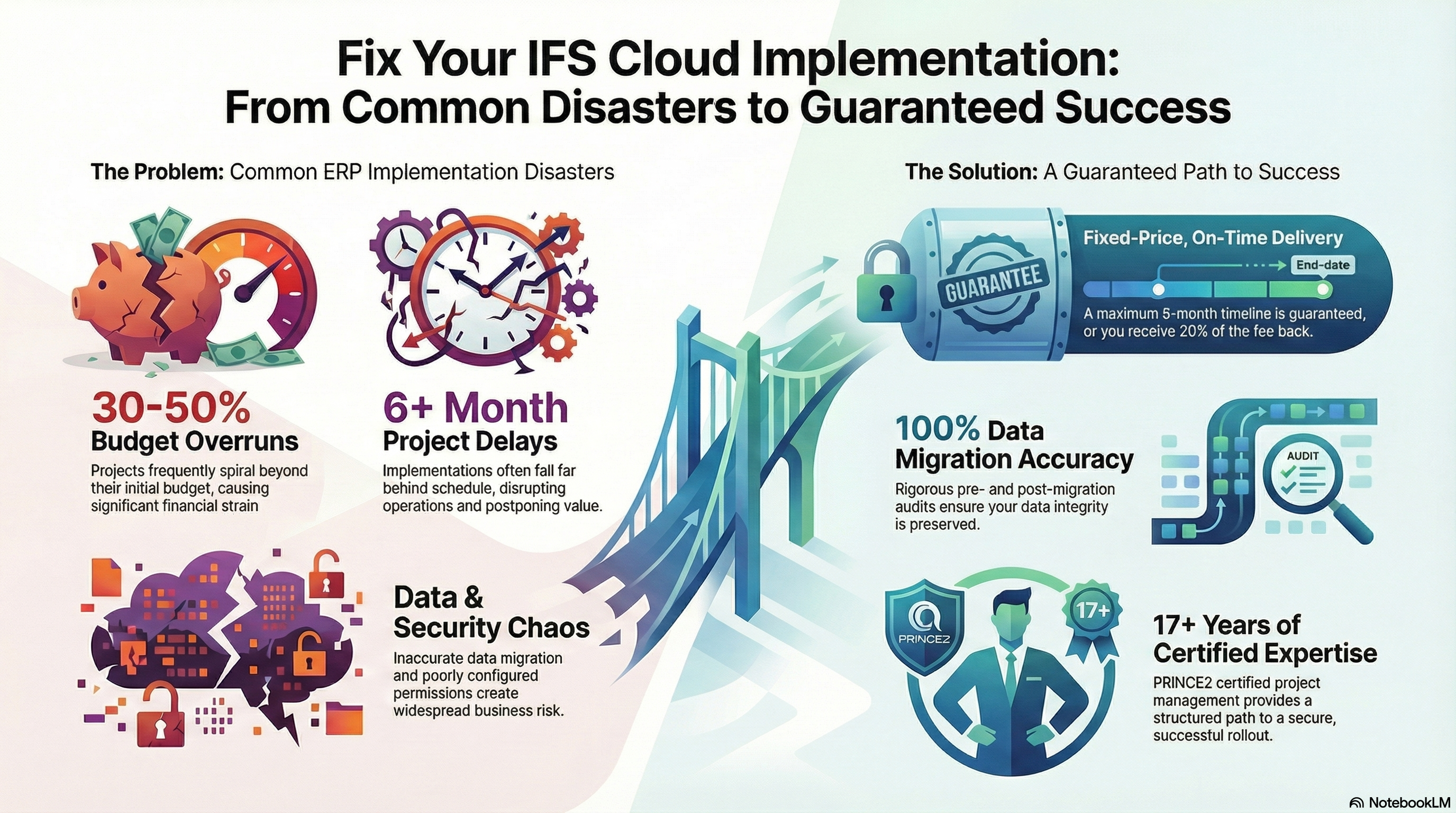
Most ERP projects fail not because of the software, but because of poor data, chaotic permissions, and «cookie-cutter» consulting. I fix these root causes:

Data Migration Nightmares

Moving legacy data often leads to errors that halt operations. I use automation tools to cleanse, validate, and migrate data with precision.

Timeline Slippage

Manual configurations cause delays. My automated methodology accelerates deployment, cutting implementation time significantly.

Security & Compliance Gaps

Default permissions are often too open. I implement granular, audit-ready Role-Based Access Control (RBAC) from the start.

Post-Go-Live Chaos

Support often vanishes after the cutover. I stay to optimize performance and ensure your team is fully capable.

Key Features of My Solution

1. Automation-Driven Data Migration

I utilize specialized ETL scripts to automate the extraction, transformation, and loading of your data. This ensures 100% accuracy and consistency, eliminating the «human error» factor common in manual migrations.

2. Accelerated Timelines

By leveraging pre-built templates and proven methodologies, I remove inefficiencies. Your IFS Cloud upgrade or deployment is completed faster, delivering a quicker Return on Investment (ROI).

3. Governance & Compliance

Security isn’t an afterthought. I automate the migration of user roles and permission sets, ensuring your ERP data remains secure, compliant, and audit-ready immediately upon go-live.

4. Comprehensive Lifecycle Support

From the initial assessment to post-go-live optimization, I manage the full project lifecycle. This includes end-user training and proactive system tuning to align with evolving business needs.

Why Choose Me?

I don’t do «cookie-cutter» ERP. Every solution is custom-built to fit your operations like a glove.

  • 17 Years of IFS Experience
  • Fixed-Price Guarantee
  • 0% Hidden Costs
Cut Through the Chaos

Not sure where to start? Send me your latest implementation progress report. Within 24 hours, you’ll get a list of the 3 biggest threats to your project.

This email address is being protected from spambots. You need JavaScript enabled to view it.

Service FAQs

I use a library of pre-built scripts for data migration and permission setup. Instead of manually configuring thousands of records, I automate the heavy lifting, allowing us to reach the testing phase in weeks, not months.

Yes. I specialize in migrating from legacy versions (IFS Applications 9, 10) to the latest IFS Cloud «Evergreen» environment, ensuring all your custom configurations and data carry over correctly.

I offer a performance-based guarantee. If the agreed-upon implementation timeline is missed due to my deliverables, I refund 20% of the fee. I also offer a 50% refund on Pilot Implementations if you are not satisfied.
Improvements of you IFS Cloud imlementation
  • Home
  • Offer
  • IFS Cloud
  • Data Governance
  • Contact
  • Implementation of IFS Cloud Data Mesh
  • Downloads
    • IFS OData Excel Client
  • Innovations
  • Business Process Optimisation