
What Problem Does This Article Solve?
Many IFS Cloud implementations suffer from "Data Decay"—where the system is technically sound but the information within it is untrusted, duplicated, or non-compliant. This article bridges the gap between technical data modeling and strategic data governance, providing a roadmap to turn your ERP into a high-performance business asset rather than a messy database.
TL;DR (Too Long; Didn't Read)
- The Core Issue: Data modeling (the blueprint) and governance (the rules) are often treated as separate silos, leading to project failure.
- IFS Cloud Context: Successful SCM and Distribution depend on precise entity relationships and strict master data standards.
- The Solution: An iterative "Evergreen" cycle where governance informs the model, and the model enforces the governance.
- The Result: Faster decision-making, audit-ready compliance, and a "Single Version of the Truth."
Data Modeling and Governance: The Unsung Power Couple of IFS Cloud
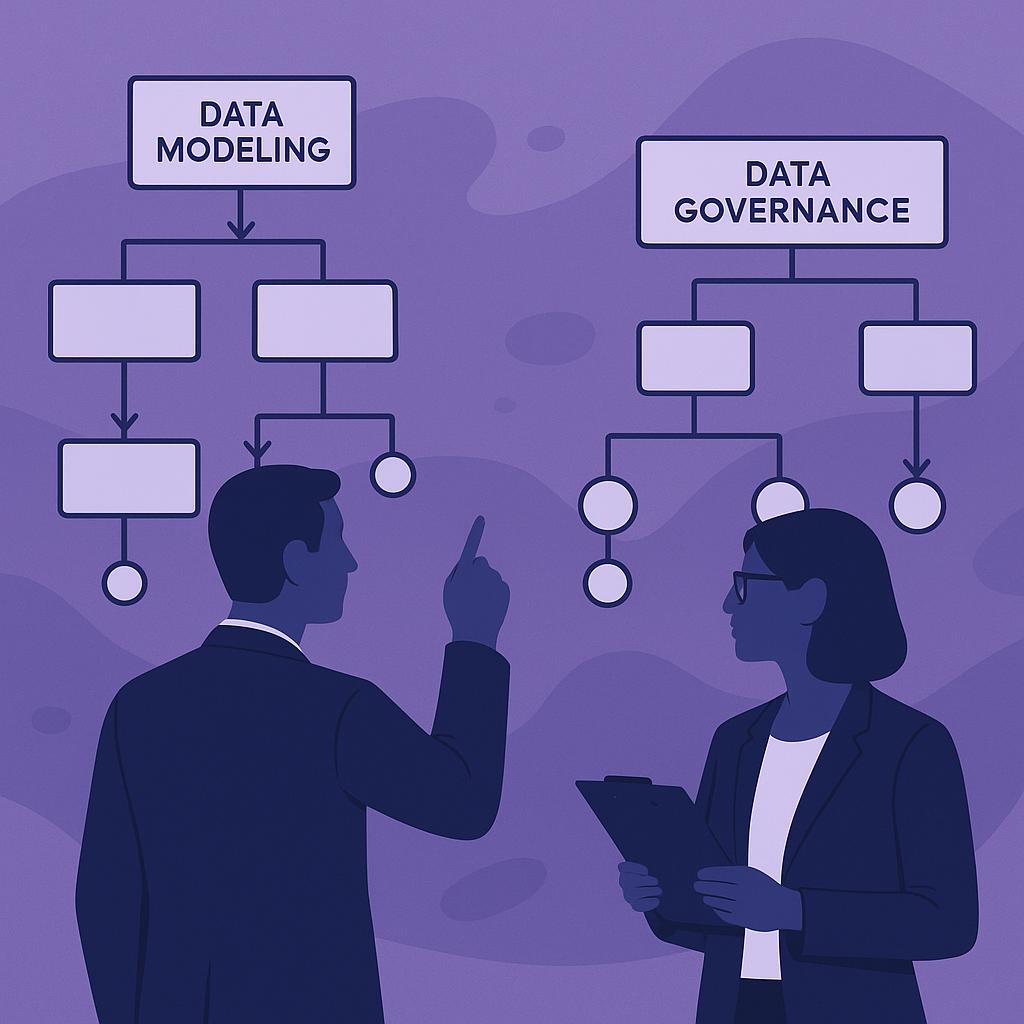
If you’ve ever been part of a data project, you’ve likely seen this scenario: The technical team is sketching complex diagrams, mapping out databases and relationships, while the governance team is knee-deep in policies, ownership charts, and compliance requirements.
It can feel like two entirely separate worlds—but in reality, without each other, both will fail. In the context of IFS Cloud implementations, the interplay between data modeling and data governance is not just important—it’s essential for long-term success.
Expert Insight
In IFS Cloud 25R1, data integrity is no longer optional. AI-driven features like "Predictive Replenishment" require pristine data models to function.
What is Data Modeling in IFS Cloud?
Think of data modeling as the blueprint of your ERP data architecture. In the world of IFS Cloud, we aren't just talking about tables; we are talking about Projections and Entities. This means defining:
- Data Entities: Defining the core objects like Customers, Purchase Orders, and Inventory Parts.
- Attributes: The granular details, such as Lead Time, Currency Code, or HS Codes for international distribution.
- Relationships: Establishing how a Sales Part connects to a Site, and how that site connects to a Warehouse Bay.
"Without a clear blueprint, every module or business unit risks building its own version of the 'data house,' leading to duplicated records, mismatched definitions, and reporting chaos."
The Role of Data Governance
If modeling is the blueprint, Data Governance is the rulebook for managing and maintaining that blueprint over time. In an IFS Cloud environment, it determines the "Who, What, and How" of your digital assets:
Access Control
Defining Permission Sets and Row-Level security to ensure users only see what they need.
Master Data Standards
Enforcing naming conventions so "Supplier A" isn't entered as "Sup. A" or "A-Supplier."
Audit Readiness
Validation rules that ensure every new part entry includes necessary environmental tax codes.
Where the Magic Happens: The Integration Loop
The real value comes when data modeling and data governance operate in a continuous loop. This is particularly true for SCM and Distribution modules where high transaction volumes can quickly degrade data quality if the loop is broken.
| Phase | How Governance Guides Modeling | How Modeling Enables Governance |
|---|---|---|
| Design | Defines compliance requirements (e.g., GDPR) that the model must support. | Provides the technical fields (Projections) to store consent data. |
| Execution | Sets the standards for "Mandatory Fields" during order entry. | Enforces those standards via IFS Cloud "Event Actions" or "Validations." |
| Optimization | Identifies where data is "dirty" or redundant. | Allows for restructuring entities to eliminate data silos. |
Why This Matters for SCM and Distribution
In the supply chain, data modeling isn't just a technical exercise—it's a financial one. Consider Inventory Valuation. If your data model doesn't correctly relate "Cost Sets" to "Part Acquisition," your financial governance will fail, leading to inaccurate balance sheets.
By aligning these two disciplines, you achieve:
- A Common "Data Language": Purchasing, Warehousing, and Finance all see the same "Part" status.
- Built-in Compliance: No more scrambling before ISO audits; the system enforces the rules by design.
- Accelerated Decision-Making: When a manager opens an IFS Lobby, they know the data is current and validated.
The Evergreen Strategy: Modeling for 2026 and Beyond
With IFS Cloud's Evergreen model (frequent updates), your data architecture must be flexible. Hard-coding logic into the database is a thing of the past. Today, we use Custom Attributes and Configuration Contexts. This allows the governance team to update rules (e.g., a new shipping regulation) without needing a full system re-code from the technical modeling team.
Practical Takeaway
If your data governance efforts feel stuck, look at your ERP data models. If your data models are out of date, review your governance processes. You cannot fix one without the other.