TL;DR
Executive Summary: Data migration is the single largest risk factor in any IFS Cloud implementation. It is not merely a technical «lift and shift» of rows and columns; it is a strategic reconstruction of your business’s digital backbone. Our Professional Data Migration Services mitigate this risk through a rigorous, audit-compliant methodology utilizing the IFS Data Migration Manager (DMM). We move beyond basic extraction and loading to perform comprehensive data sanitization, structural transformation, and iterative validation (Mock Loads). By categorizing data into Basic, Master, and Transactional tiers and employing a phased «Delta Load» cutover strategy, we ensure zero data loss, maintain strict regulatory compliance (GDPR), and guarantee that your system goes live with high-integrity data that drives immediate operational value. Key outcome: Minimized downtime, 100% data reconciliation, and a stable foundation for your future business processes.
The Strategic Imperative of Precision Data Migration
In the landscape of modern Enterprise Resource Planning (ERP), data is not just a byproduct of operations; it is the most valuable asset an organization possesses. As enterprises transition to IFS Cloud to leverage its evergreen capabilities, AI-driven insights, and composable architecture, the quality of the data inhabiting that system becomes the primary determinant of success. The phrase «Garbage In, Garbage Out» is a cliché for a reason — it is fundamentally true. An IFS Cloud environment, no matter how perfectly configured, cannot function if populated with obsolete, duplicated, or corrupted legacy data.
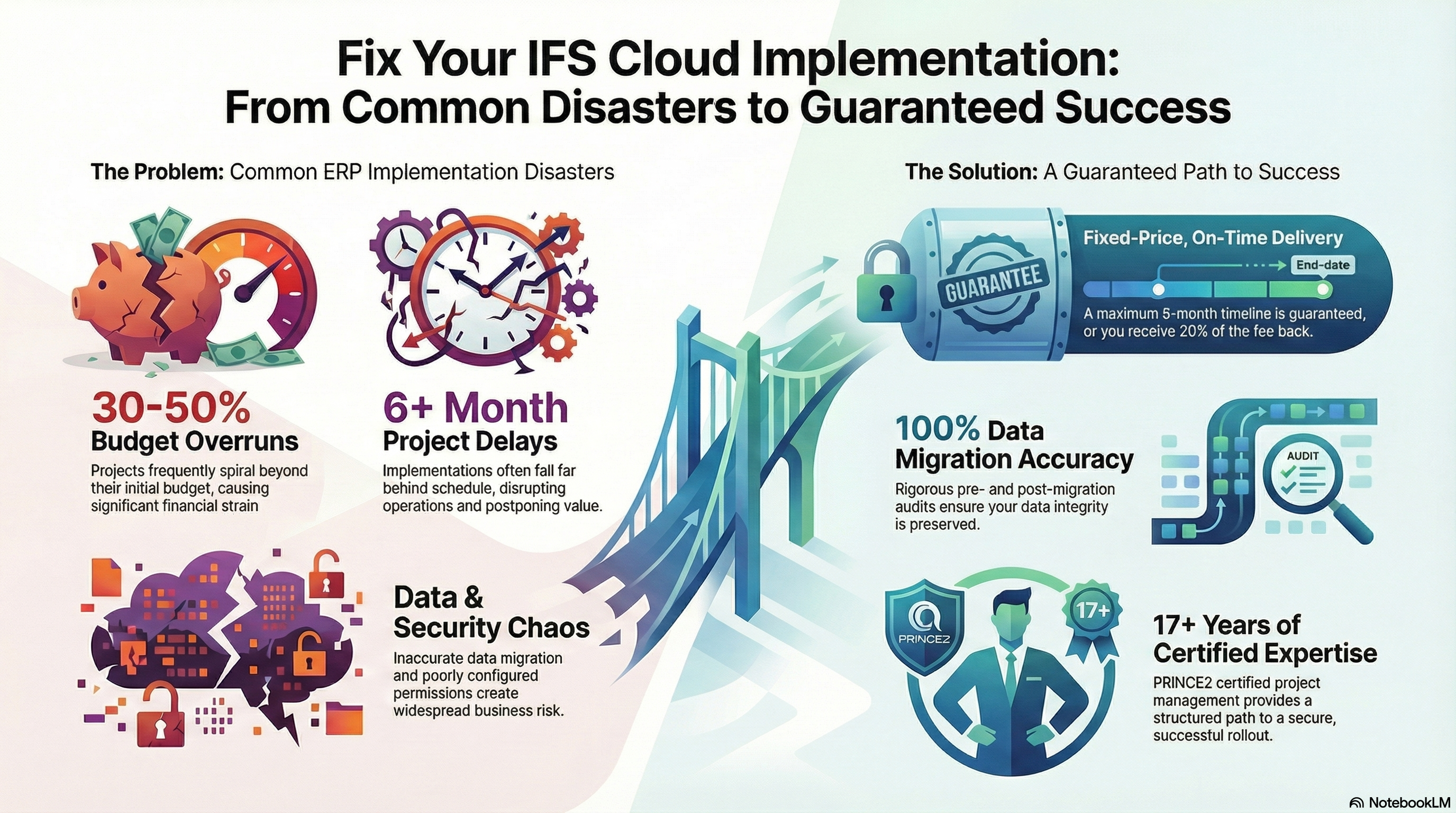
The stakes are exceedingly high. Industry analysis consistently indicates that data migration failures are a leading cause of ERP project delays, budget overruns, and, in worst-case scenarios, total implementation failure. When migration is mishandled, the downstream effects are catastrophic: supply chains break down due to missing inventory records, financial reporting fails due to misaligned general ledger balances, and customer satisfaction plummets due to lost order history.
Our Professional Data Migration Services are engineered to eliminate these risks. We view data migration not as a background IT task, but as a critical stream within the overall implementation project. By combining deep technical expertise in IFS Cloud architecture with robust data governance principles, we ensure your transition is seamless, secure, and sets the stage for operational excellence.
Deconstructing the Data Universe: What We Migrate
A successful migration requires a nuanced understanding of the different types of data within an ERP ecosystem. We do not treat all data equally; each category requires a specific strategy, timing, and validation approach.
Basic Data
This is the foundational configuration data that defines the rules of the system. It includes Payment Terms, Delivery Terms, Units of Measure, Currency Codes, and Site definitions. Migration of Basic Data is critical as it validates the system configuration and serves as a prerequisite for all subsequent data loads.
Master Data
The core entities that drive your business: Customers, Suppliers, Parts, Bill of Materials (BOMs), Routings, and Fixed Assets. This data is static but high-volume. It typically requires the most extensive cleansing to remove duplicates (e.g., merging three records for the same supplier) and standardize formatting.
Transactional Data
Open operational records such as Open Customer Orders, Purchase Orders, Shop Orders, and GL Balances. Migrating open transactions is complex and highly sensitive to timing. We employ specific «Cutover Strategies» to migrate only what is necessary (Open items) while archiving closed history to a data warehouse or accessible legacy view.
Our End-to-End Migration Methodology
Leveraging over 17 years of specialized experience in the IFS ecosystem, we have refined a structured, iterative methodology that guarantees predictability. We utilize the IFS Data Migration Manager (DMM), a sophisticated toolset embedded within the IFS platform, to manage the extraction, transformation, and loading (ETL) lifecycle.
Phase 1: Discovery, Assessment & Profiling
Before a single byte of data is moved, we must understand the landscape. Legacy systems often hide decades of «technical debt» — adhoc workarounds, unused fields, and inconsistent data entry standards.
- Data Profiling: We use automated tools to scan your legacy databases, generating reports on column density (how full a field is), value distribution (how many variations exist), and format consistency.
- Scope Definition: We work with your business process owners to define exactly what needs to move. Do you need 10 years of sales history in the new live system, or is the current fiscal year plus open orders sufficient? Reducing volume reduces risk.
- Risk Identification: We flag high-risk areas early, such as special characters that might break API calls, or missing mandatory fields required by IFS Cloud logic.
Phase 2: Cleansing & Enrichment Strategy
This phase is where the «heavy lifting» occurs. Data cleansing is rarely a purely technical exercise; it requires business decisions. Our consultants facilitate workshops to drive these decisions.
Activities include:
- De-duplication: Identifying and merging duplicate records (e.g., «ABC Corp» vs. «ABC Corporation») to ensure a «Golden Record» in the new system.
- Standardization: Enforcing global standards for addresses (ISO codes), phone numbers, and names to ensure data uniformity.
- Enrichment: Populating new fields required by IFS Cloud that didn’t exist in the legacy system. For example, adding new «Tax Classification» codes or «Sustainability Metrics» to part records.
- Compliance Checks: Ensuring all data to be migrated complies with GDPR, CCPA, and other regulatory frameworks, specifically regarding the handling of Personally Identifiable Information (PII).
Phase 3: Mapping & Transformation Logic
IFS Cloud utilizes a specific data structure based on «Projections» (APIs). We map your legacy flat files or SQL tables to these target structures. This involves complex transformation logic, not just simple field-to-field copying.
We build extensive Translation Tables (Cross-Reference tables) to convert legacy values to IFS values. For instance, your legacy system might call a payment term «NET30», while IFS Cloud expects «30NET». Our mapping engines automate this translation, handling thousands of records in seconds while logging any exceptions for manual review.
Phase 4: Iterative Execution (The «Mock Loads»)
Migration is not a «Big Bang» event that happens once. We believe in the power of iteration. We integrate migration cycles with your project’s Conference Room Pilots (CRPs).
- Mock 1 (Technical Validation): A test load to verify the mapping logic and catch syntax errors.
- Mock 2 (Business Validation): Loading data for User Acceptance Testing (UAT). Business users interact with the migrated data in real scenarios, verifying that a migrated Purchase Order actually processes correctly through the Receipt workflow.
- Mock 3 (Cutover Rehearsal): A timed «Dry Run» of the final go-live weekend. We measure exactly how long the extraction, transformation, and load takes to the minute, allowing us to build a precise «Cutover Plan.»
Phase 5: Validation & Reconciliation
Trust is good, but verification is mandatory. We utilize a dual-validation approach:
- Count Validation: Comparing record counts (e.g., 5,000 customers in legacy vs. 5,000 in IFS).
- Value Reconciliation: Comparing financial totals (e.g., Total Receivable balance in Legacy vs. IFS). We provide sign-off sheets for Finance Directors to physically sign, confirming the balances match to the penny.
Phase 6: The Cutover & Go-Live
This is the culmination of months of preparation. Because we have rehearsed this (Mock 3), the event is controlled and predictable.
- Delta Loads: To minimize downtime, we often migrate Master Data (Customers, Parts) weeks in advance. On the go-live weekend, we only migrate the «Delta» — the changes that occurred since the last load — and the dynamic Transactional Data.
- Go/No-Go Checkpoints: We establish clear checkpoints throughout the cutover weekend. If data criteria are not met, we have predefined rollback plans, ensuring business continuity is never compromised.
Leveraging Technology: The IFS Data Migration Manager
Modern problems require modern tools. We rely heavily on the IFS Data Migration Manager (DMM), specifically designed for cloud deployments. Unlike generic ETL tools, DMM understands the business logic of IFS.
DMM allows for:
- Validation at Source: DMM checks data against IFS logic rules before it tries to load it, preventing simple errors from clogging the migration logs.
- Smart Deployment: It can manage migrations across different environments (Build, Test, Production), ensuring that the configuration used in testing is exactly what is used in production.
- Legacy Legacy handling: It manages the mapping of complex «Legacy to Target» structures, keeping an audit trail of every transformation decision made.
Post-Migration Optimization: Beyond Go-Live
The project doesn’t end when the switch is flipped. We provide dedicated Hypercare Support immediately following go-live. During this period, our data experts remain on standby to address any anomalies that users discover during day-to-day operations.
Furthermore, we assist in establishing a robust Data Governance Framework. Having cleaned your data, we help you put processes in place to keep it clean. This includes configuring permission sets, setting up mandatory fields, and creating Data Quality Dashboards within IFS Lobbies to monitor the health of your master data continuously.
Why Trust Us with Your Data Strategy?
Our expertise goes beyond «moving files.» We understand the business context of your data. We know that a «Part Number» isn’t just a database string; it’s the link between your engineering, supply chain, and sales teams. We safeguard your data integrity to empower your business for future success.
Don’t let data migration complexities paralyze your ERP project. Trust the experts for a seamless transition.
Request a Data Strategy Consultation