Strategy Summary (TL;DR)
Data Mesh is not a software upgrade. It is a structural demolition of the centralized data bottleneck. This article solves the "Data Swamp" problem where IT becomes a gatekeeper, paralyzing business agility. By shifting ownership to domain experts, we move from a monolithic failure to a distributed success model tailored for IFS Cloud environments.
Centralized Architecture is Your Single Point of Failure
If your business units wait weeks for IT to generate a simple report, your data strategy is dead on arrival. For decades, the industry pushed "Data Lakes" and "Data Warehouses" as the ultimate solution. In reality, they created a massive organizational bottleneck.
Data Mesh is the admission that central IT cannot scale at the speed of business demand. It is the tactical decision to decentralize intelligence.
By moving to a Data Mesh, we solve the knowledge-gap problem. The people who generate the data, such as warehouse managers, procurement officers, and production planners, are the ones who own it. They are no longer just "users"; they are Product Owners.
The Four Pillars of Data Mesh for IFS Cloud
Implementing a Data Mesh within an IFS Cloud ecosystem requires more than just terminology. It requires a hard shift in how you view every transaction in the system.
1. Domain-Driven Ownership
In a standard ERP setup, the database is seen as a giant bucket. Data Mesh shatters this. Finance owns the General Ledger data products. Procurement owns the Supplier Performance data products. If the data is wrong, the domain team fixes it at the source.
2. Data as a Product (DaaP)
Data is not a byproduct. It is a product sold to the organization. Each domain must ensure their data products are Discoverable, Addressable, and Trustworthy. If Sales provides a "Revenue Forecast," it must include the metadata (Glossary) for Finance users.

Deep Dive: Data Product Thinking
Treating data as a product changes the ROI from cost of storage to the value of insight.
Explore Product Strategy3. Self-Serve Data Platform
IT changes from "Gatekeeper" to "Infrastructure Provider." This platform must provide the tools for storage and OData connectivity, allowing domain experts to build pipelines without writing complex SQL.
4. Federated Governance
Decentralization is not chaos. Federated governance ensures teams follow global standards for security. We automate these rules. If a data product lacks a "GDPR compliance" tag, the platform blocks its publication.
The Real Shift: Not Just Tech, But Culture
Moving to data mesh flips corporate culture on its head. Legacy architectures force dependence on central IT. Data mesh pushes responsibility and innovation outward. This pressures organizations to boost training, redefine accountability, and accept that local mistakes are a necessary price for overall agility.
When you give a Production Planner the power to define their own data KPIs, you remove the "IT messed up the report" excuse. This accountability is the secret sauce of high-performing IFS Cloud implementations.
Strategic Impacts: Beyond the Buzzwords
- Compressed Decision Cycles: Real-world examples show a 30 percent drop in time-to-insight. In IFS, your supply chain reacts to shipment delays in minutes, not days.
- Democratized Innovation: Domain specialists own the data and invent solutions, such as custom Lobbies or automated Workflows, that central IT would never have the context to build.
- Regulatory Resilience: In a mesh, Clean Core principles are easier to maintain. By separating data products from core ERP transactions, updates become seamless.
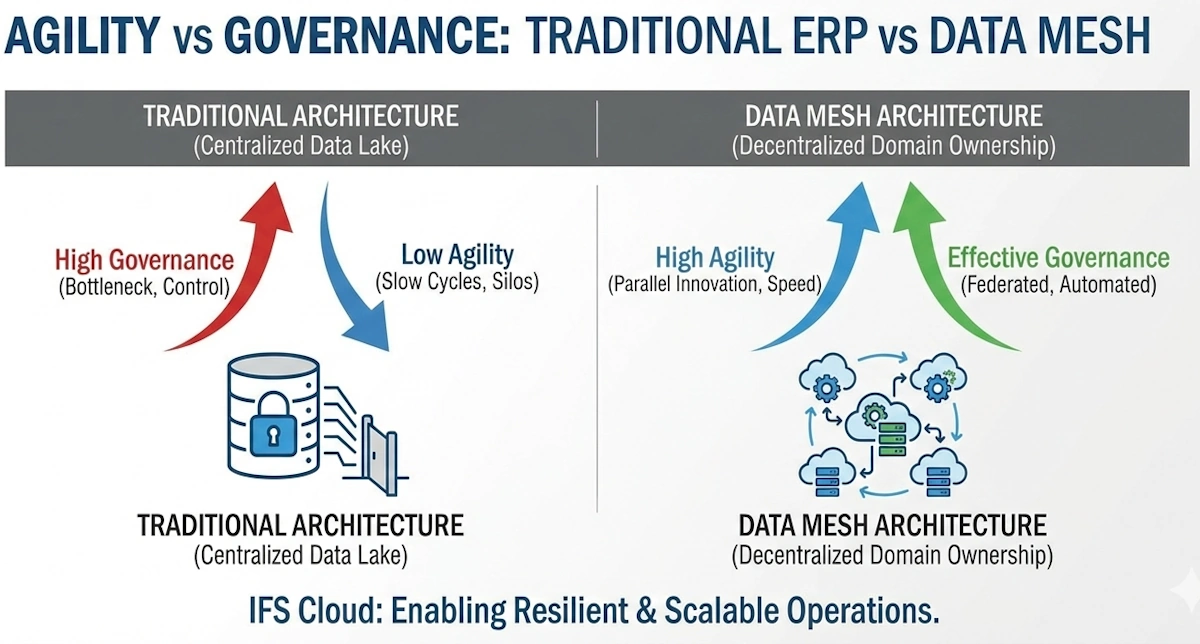
Data Mesh vs. Traditional Architectures
| Feature | Data Mesh (Decentralized) | Traditional Architecture |
|---|---|---|
| Primary Owner | Domain Business Teams | Central IT / Data Engineers |
| Bottlenecks | Distributed (Low Impact) | Single Point of Failure (High) |
| Governance | Federated and Automated | Manual and Top-Down |
| Agility | High; parallel development | Low; sequential requests |
Expert FAQ: Data Mesh in IFS Cloud
Will Data Mesh lead to data silos?
No. Silos are born from a lack of transparency. Data Mesh requires every domain to publish a "Data Catalog," making data more visible than a central lake ever could.
Do we need a new toolset for this?
IFS Cloud provides the foundation via Projections and OData. The tool you need most is a change in organizational mindset and a robust Enterprise Book of Rules.
Is Data Mesh only for large enterprises?
No. Even mid-sized firms suffer from the "One Overworked Data Guy" syndrome. If you have more than three distinct departments, you already have the domain boundaries needed for a mesh.
The transition to Data Mesh is a survival move. In a world of AI-driven competition, those who hide their data behind a central gatekeeper will be outpaced by those who treat data as a living product. Start decentralizing your domain intelligence today.