TL;DR & Problem Solved
The Problem: Most ERP projects are bloated monuments to corporate silos. They fail because centralized IT cannot keep up with domain-specific needs, leading to operational paralysis during go-live.
The Solution: This article provides a blueprint for Data Mesh Federated Governance. It moves ownership from a central bottleneck to the actual business domains, enforcing "Clean Core" discipline through automated contracts rather than manual bureaucracy.
The Brutal Mechanics of ERP Failure
ERP implementations are notorious for high failure rates. This is not a software bug; it is a governance crisis. When teams operate in silos, they customize modules in isolation, treating the ERP like a personal playground rather than an enterprise asset.
In 1999, Hershey’s became a cautionary tale. They invested in SAP but lost US $100 million in unfulfilled orders. Their share price dropped 8%. The software worked. The governance did not. Finance, supply chain, and HR teams customized their modules without cross-functional alignment. They built brittle integrations that snapped under the pressure of real-world operations.
This scenario repeats every week in the IFS Cloud world. Architects neglect the "Clean Core" philosophy. They prioritize short-term "business requests" over long-term system health. Without a unified framework, advanced systems exacerbate silos. You end up hosting a mess on a more expensive cloud server.
Data Mesh: The End of the Centralized Bottleneck
"Autonomy without enterprise glue is just a fancy name for chaos. Data Mesh is that glue."
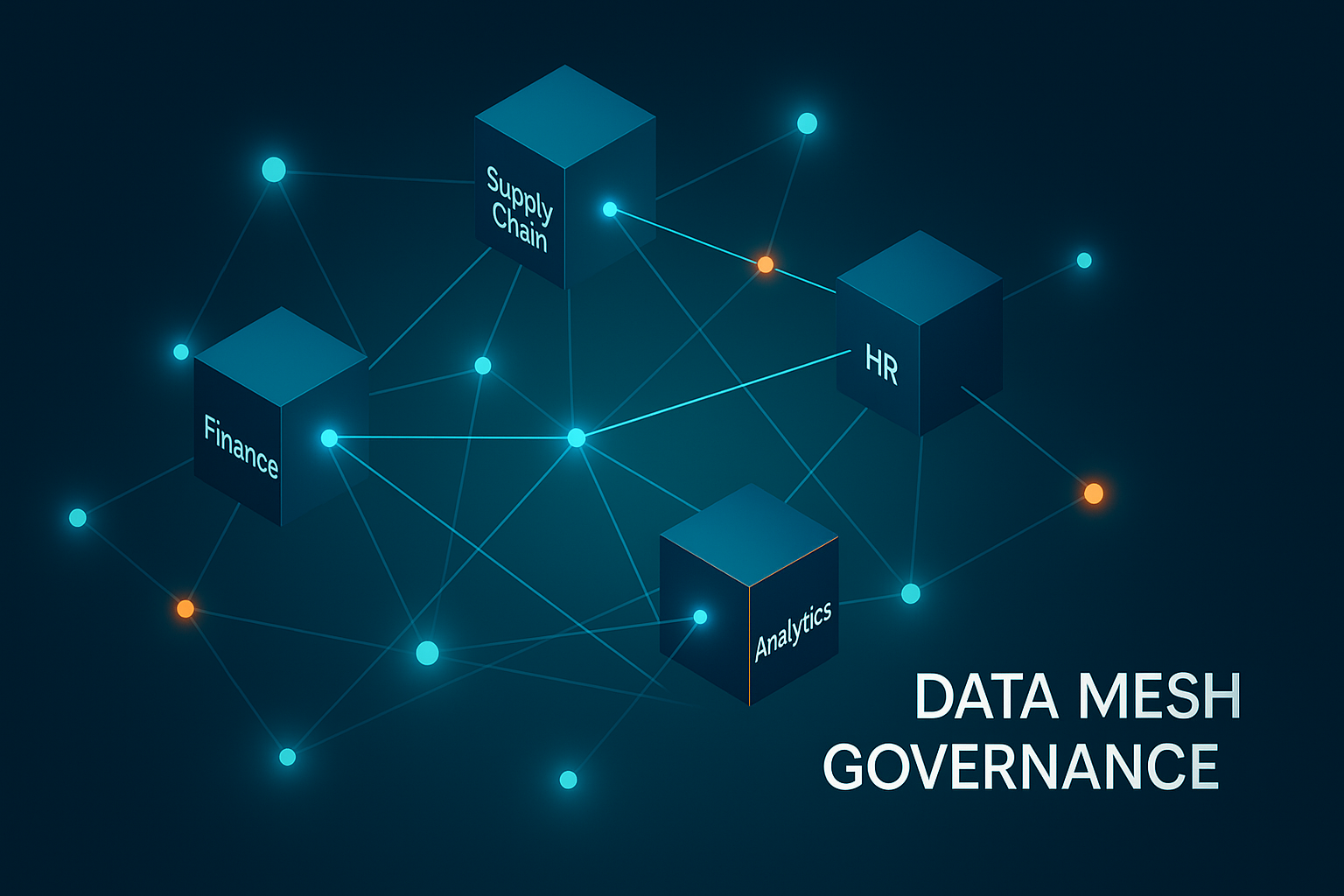
Data Mesh redefines ownership. It treats data as a product, not a byproduct. In this model, domains like Finance or Logistics retain autonomy but must adhere to global standards.
The Core Pillars of the Mesh
- Domain Ownership: The people who create the data (e.g., Warehouse Managers) own the data. IT is no longer the middleman.
- Self-serve Infrastructure: Empowering teams to manage data without waiting for a ticket to be resolved by a central admin.
- Federated Governance: Consistency via shared SLAs and automated policy enforcement.
Traditional models rely on top-down mandates that everyone ignores. Data Mesh embeds governance into the lifecycle. It prevents fragmentation by making "the right way" the easiest way for consultants.
ERP Pitfalls vs. Data Mesh Solutions
| Classic ERP Failure | Data Mesh Risk | Governance Solution |
|---|---|---|
| Over-customized modules breaking the "Clean Core" | Inconsistent schemas across departments | Universal Product Contracts: Standardized schemas for data lineage and freshness. |
| Integration testing deferred until it is too late | Products launch without downstream validation | Shift-left Contract Testing: Automated validation early in the pipeline. |
| Training focuses on buttons, not workflows | Local optimization ignoring enterprise KPIs | Cross-domain Architecture Reviews: Aligning local modules with global goals. |
The CRIMS Connection: Governing the Mess
In the context of IFS Cloud, governance is often discussed through CRIMS (Configurations, Reports, Integrations, Modifications, Security). Most companies treat CRIMS as a checklist. This is a mistake. CRIMS is a risk registry.
If you do not govern Modifications with the same rigor as a Data Mesh product, you are concreting your system. You will never take a Service Update without weeks of regression testing. Data Mesh principles force you to treat every modification as a "Data Product" with a contract, an owner, and a sunset date.
Four Steps to Mesh-Ready Governance
1. Codify the Contract
Stop using Word documents for specs. Publish canonical data models (Customer, Invoice, Shipment) with versioned SLAs. If a field changes in IFS, the contract fails the build.
2. Automate Policy as Code
Governance is not a meeting; it is a script. Embed lineage capture and PII masking directly into your CI/CD pipelines. Eliminate manual errors or prepare for a data breach.
3. Appoint Integration Champions
Rotate your senior analysts into different domain teams. They act as diplomats, ensuring that the "Sales" configuration doesn't break the "Finance" reporting.
4. Measure the Mesh
Track lead time from data request to insight. If it takes three weeks to get a new field into a report, your governance is a failure. Celebrate reuse, not just new builds.
Frequently Asked Questions
Why do ERP projects fail despite advanced tech?
Silos. Teams customize in isolation, creating misaligned processes. Data Mesh enforces ownership at the source, preventing integration gaps before they start.
Is Data Mesh just for Big Data?
No. It is an architectural mindset. Even a mid-sized IFS Cloud implementation benefits from treating the "Warehouse" as a data domain responsible for its own accuracy.
What tools are required?
Automation is the priority. Use CI/CD pipelines (like Jenkins or Azure DevOps) and a central data catalog. You need tools that enforce "Policy as Code."
Domain autonomy without enterprise glue is a disaster waiting to happen. At your next meeting, audit your three most critical datasets. If they lack a named owner or a published contract, you are building on sand. Fix the governance or prepare for the failure.